
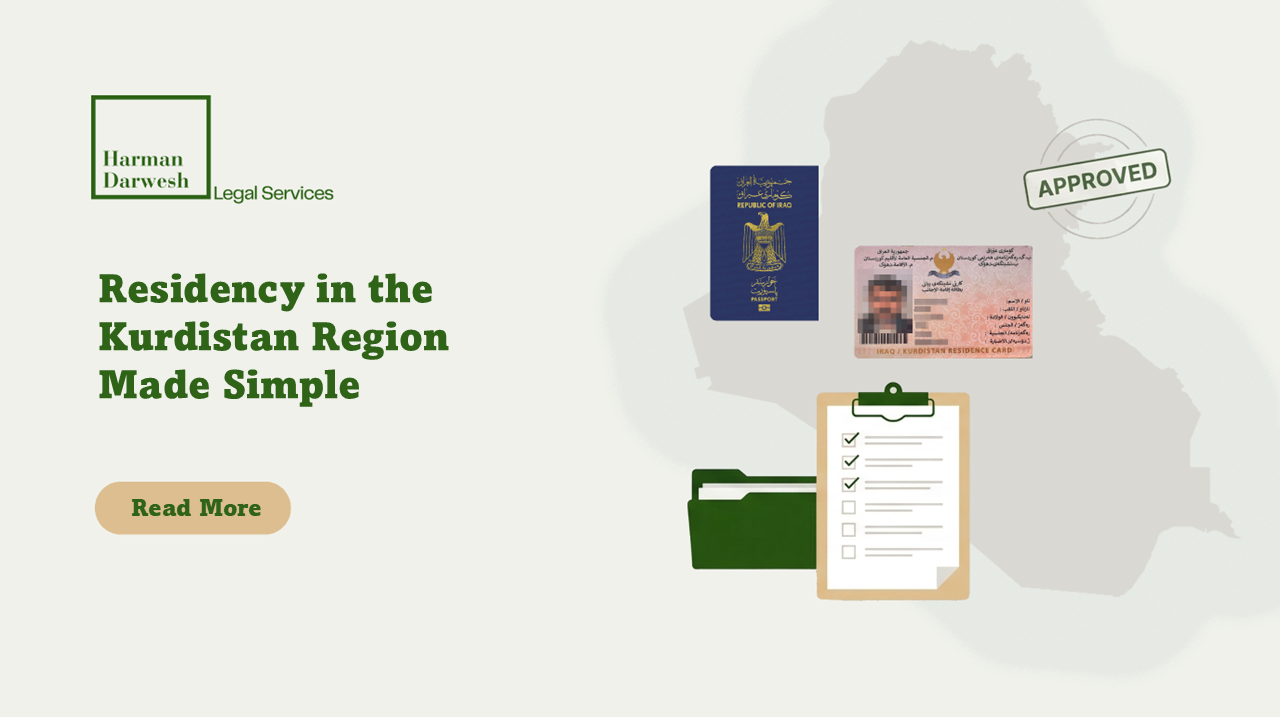
Whether you’re investing, taking up employment, or relocating with your family, the Kurdistan Region of Iraq (KRI) offers several pathways to lawful stay—provided your visa is eligible, and your sponsor is compliant. This guide walks you through the essentials to help you plan with confidence.
1) Choose your pathway
- Investor residency: Available to qualifying investors; typically multi-year and may extend to immediate family.
- Work-residency (employees): Tied to a sponsoring employer; generally issued for fixed periods and renewed if employment and compliance continue.
- Family reunification/dependents: Residency linked to the principal investor/employee, based on proof of relationship.
2) Start with your visa
Residency is issued only if your current visa/status can be converted. Before you begin, have an experienced lawyer—or the local Residency Directorate—review your visa to confirm eligibility and the correct route.
3) Employer-sponsored route: what your company must have in place
- Maintain active registration and be up to date on filings and taxes.
- Hold open, current files with Social Security and the Residency Directorate.
- Meet workforce localization expectations (commonly referred to as the “75/25” rule, i.e., a predominantly local workforce).
- Obtain a work permit for the role in addition to the residency card.
- Pay social-security contributions monthly—missed payments can block renewals.
4) Investor route: eligibility and duration
Where investor status is confirmed through the relevant authorities, residency is commonly granted for several years, subject to continued investment activity and general compliance. Spouses and minor children typically qualify as dependents.
5) Family reunification & dependents
Spouses and children apply on the back of the principal’s valid status. Expect to provide legalized/translated relationship documents (e.g., marriage and birth certificates), copies of passports, and sponsor letters, as well as complete security and medical steps.
6) Health, biometrics & interviews
Most applicants complete medical/blood tests and an interview at the Residency Directorate. Some steps are coordinated between the directorate and MoLSA (for example, verifying health results and scanning approvals). Scheduling and sequencing can vary by governorate.
7) Validity & renewals
Employees: Cards are commonly issued for defined periods (e.g., 6–12 months) and renewed with proof of ongoing employment, work-permit validity, and social-security compliance.
Investors: Often multi-year; confirm current durations before filing.
Begin renewals early to avoid gaps—overstay penalties can apply if your card lapses.
8) Typical fees & budgeting
- Initial residency processing for first-time applicants (often cited in the range of IQD 500,000–1,000,000).
- Residency card issuance (around IQD 175,000).
- Medical/blood tests (commonly around IQD 85,000).
- Administrative/postal fees (around IQD 55,000).
- Annual health insurance (frequently cited at IQD 375,000).
- Late-processing penalties (for example, around IQD 20,000 per day).
- Also budget for translations/legalizations and any professional fees where you appoint counsel; treat figures as indicative and confirm locally before filing.
How our firm helps
- Pre-check & planning: Visa convertibility review, route selection, and document lists tailored to your situation.
- Sponsor compliance: Quick audit of employer registration, work-permit status, social-security filings, and workforce ratios.
- Filing & follow-through: End-to-end handling of work-permit and residency applications, medicals, and directorate appointments.
- Family applications: Coordinated dependents’ filings with translation/legalization support.
- Renewals & reminders: Proactive timelines to prevent lapses; fixed-fee packages available for standard cases.
Need a residency permit or renewal? We’ll handle the paperwork for you—so you can focus on your plans in the KRI.
Disclaimer: This guide is for general information and does not constitute legal advice. Facts and fees change; obtain advice tailored to your circumstances before acting.